How to Choose a Meat Tenderizer for Wholesale: 5 Checks Before You Order
A meat tenderizer looks simple, but the wrong one is too light, rusts, or traps food at the joint. Here are five checks — material, balance, head, handle, and order terms — to get right.
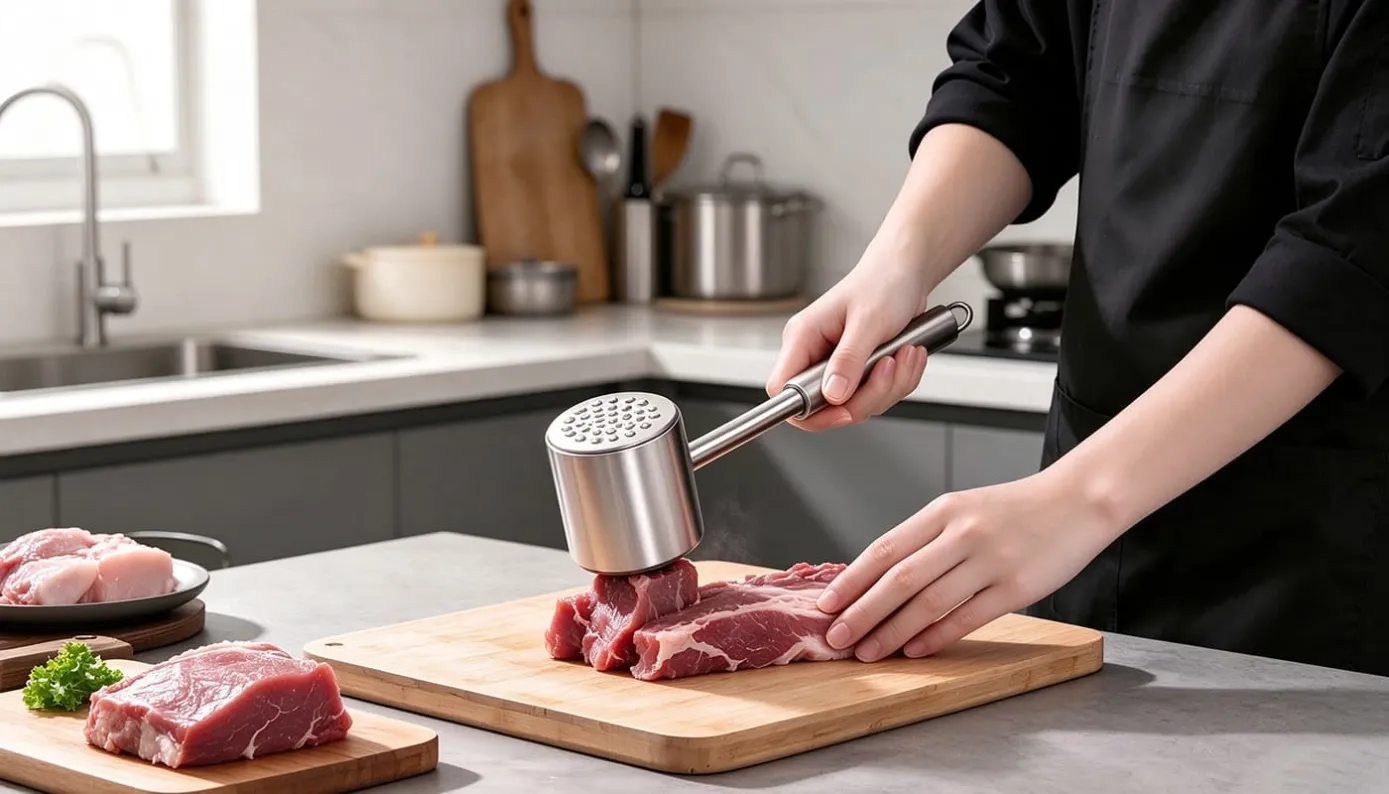
Walk down the meat-prep aisle of any wholesale showroom and the tenderizers all look alike: a steel head, a handle, a hanging loop. Pick one up, though, and the differences show themselves in seconds — the weight in the hand, the balance of the head, the way the handle meets the metal. The question is not whether a tenderizer can flatten a steak. Any of them can, once. The question is whether it still does the job quickly and cleanly after a year of daily prep.
A tenderizer earns its place not by looking right on the shelf, but by saving strokes at the prep table and rinsing clean in seconds. Here are five checks that separate the two.
Meat tenderizers at a glance
| Type | Material | Best for | Watch out for |
|---|---|---|---|
| Solid steel mallet, dual-sided (LK LYK106) | Food-grade SS304 | Home and small commercial prep | Check the head is solid, not hollow |
| Cast aluminium mallet | Aluminium | Light home use | Lighter strike; can dent and stain |
| Wooden mallet | Hardwood | Occasional home use | Absorbs moisture; harder to clean |
| Needle tenderizer | Steel blades, plastic body | Piercing thick cuts | Punctures rather than flattens; more parts to clean |
| Plastic mallet | Plastic | Very light use | Too light for steak; can crack |
1. Check the material — solid food-grade 304 stainless steel
A tenderizer lives in the wettest corner of the kitchen: raw meat, marinade, and a sink full of water. That is why the material matters more here than on almost any other hand tool. Our meat hammer (LYK106) is made entirely from food-grade 304 stainless steel, which resists rust in daily wet use and leaves nothing behind on food — no coating to flake, no wood grain to hold moisture, no plastic to stain. A hollow head or a plated finish can look identical on the shelf, so check that the head is solid steel, not a thin shell.
2. Check the weight and balance — the handle does the work
Tenderizing is repetitive work, and the tool should do most of it. A 27 cm handle gives the leverage for a full strike without forcing the wrist, while a solid steel head carries the force into the meat so the cook does not have to. Too light, and every steak takes twice as many strokes — prep time lost on every service. Too heavy, and the wrist tires before the shift ends.
3. Check the head: two faces, two jobs
One head should do two different jobs. The spiked side breaks down tendons and connective tissue, which shortens marinating time and makes cheaper cuts cook tender. The flat side evens out the thickness so a steak cooks uniformly instead of drying at the thin edge while the thick middle stays raw. Our head is 5.7 cm across — wide enough to cover a steak in fewer strokes, small enough to work on a home cutting board. The same two faces also crush garlic, nuts, and ice, which is why the tool sells beyond the meat aisle.
4. Check the handle and the joint — where cheap tenderizers fail
Most tenderizers fail at the joint, not the head. A wooden handle riveted to a metal head works loose, and the gap where the two meet traps meat juice that no rinse can reach. A one-piece stainless steel body has no joint to fail and no crevice to clean: a smooth, seamless surface that rinses clean and goes straight into the dishwasher. A hanging loop at the tail matters more than it looks — in a small kitchen or a crowded prep station, a tool that hangs up is a tool that gets used.
5. Check cleaning and order terms before you commit
A tenderizer that is hard to clean will be the first tool a buyer stops reordering. Ours is dishwasher safe with a seamless surface, so a restaurant can run it through the same wash as the rest of the prep tools. On the order side, the packing is straightforward: 1 piece per box, 40 boxes per carton, carton size 46 × 36 × 29 cm, with an MOQ of 80 pieces. That is a small first order for a tool that pairs naturally with the rest of a kitchen tools range, and it can be mixed into one container with other items.
How buyers in different markets choose
In the United States, the tenderizer is a steakhouse and barbecue tool first: buyers want solid steel, dishwasher-safe construction, and a head that survives daily high-volume prep. In Europe, where kitchens run smaller, buyers weigh storage and versatility more — a hanging loop and a tool that also crushes nuts and garlic earns its place on a crowded rail. In Latin America, where parrilla cooking and neighbourhood butcher shops are part of daily life, buyers look for one durable tool that serves both home cooks and small restaurants.
Frequently asked questions
Is stainless steel better than wood or aluminium for a meat tenderizer?
For wet prep work, yes. Food-grade 304 stainless steel will not absorb moisture the way wood does, will not dent and stain the way aluminium can, and can go in the dishwasher after every use. Wood needs careful drying, and a plastic mallet is too light to flatten a steak properly.
What size should I stock first?
A 27 cm overall length with a 5.7 cm head covers most orders — long enough for leverage at a prep table, short enough for a home kitchen.
Can the same tenderizer serve home cooks and restaurants?
Yes. The dual-sided head and the 27 cm handle suit both: home cooks use it for weeknight steak and chicken, while steakhouses and small diners use it for daily meat preparation. That shared use is what makes it a steady reorder line.
Conclusion
The five checks are simple — solid food-grade 304 steel, a balanced 27 cm handle, a dual-sided 5.7 cm head, a joint-free body, and clean packing terms — and together they decide whether the tool becomes a staple or a drawer filler.
Browse our kitchen tools range and tell us your target sizes and quantities — we will confirm availability and packing for your next container.