Trends
Small Kitchens, Big Opportunity: 5 Kitchen Organization Trends Wholesale Buyers Should Stock for 2026
Compact urban living is reshaping demand for dish racks, sink caddies and countertop organizers. Here are five product trends importers and retail buyers should build into their 2026 sourcing plans.
Small Kitchens, Big Opportunity
Urban apartments keep getting smaller while kitchens keep doing more of the work. In major cities across North America, Europe, the Gulf and East Asia, renters and homeowners alike are cooking at home more, storing more on the countertop, and looking for any product that multiplies usable space without a renovation. For importers, distributors and retail brands, that makes the "humble" dish rack one of the most quietly strategic categories in metal houseware.
At LK Household we manufacture and supply sinkware, kitchen tools and storage products for OEM and ODM programs worldwide. Here are the five organization trends we see shaping buyer demand into 2026 — and how to build a range around them.
1. Two-tier and expandable dish racks: more capacity per square inch
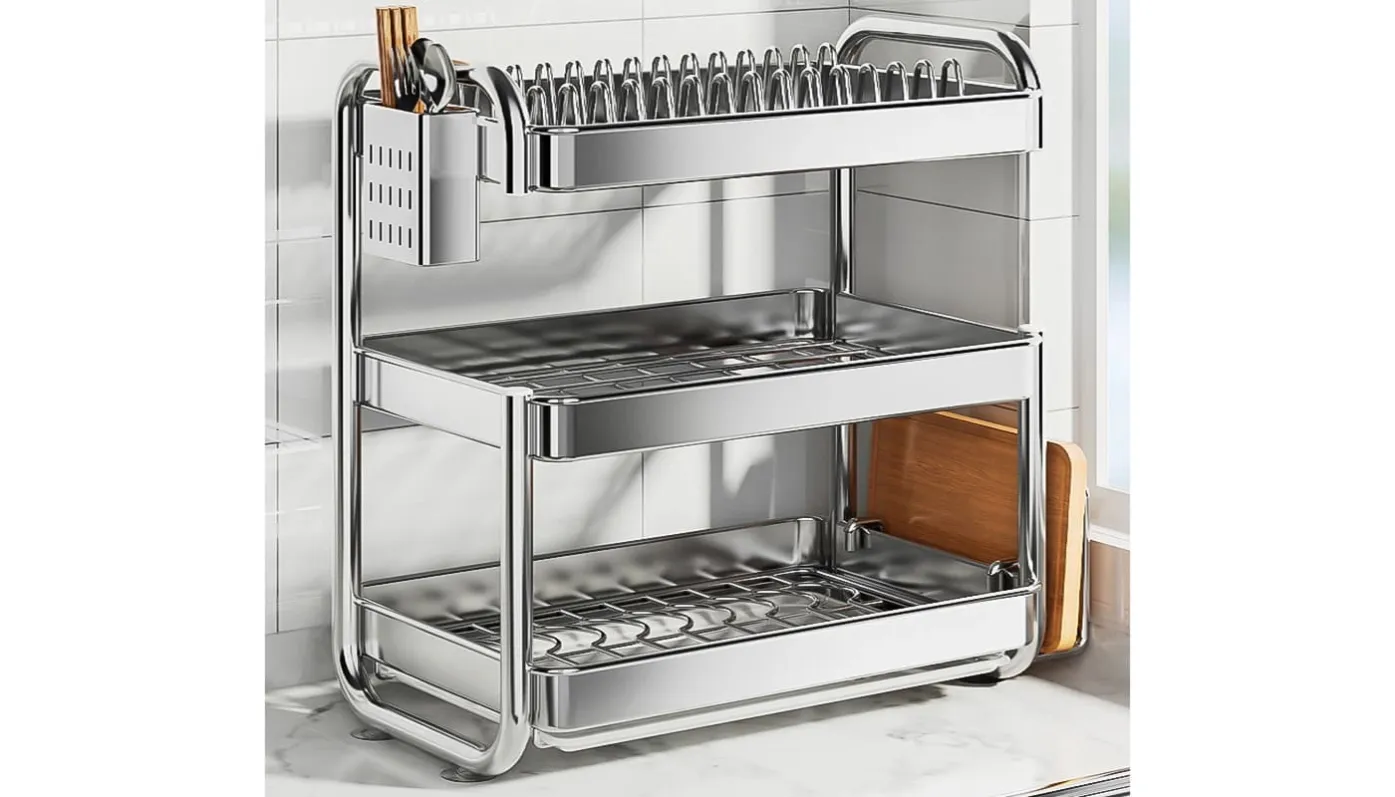
The single most consistent request from retail buyers over the past seasons has been simple: same countertop footprint, more dishes. Two-tier dish racks answer that by stacking plate and cup capacity vertically, which is why they now anchor most mid-range and premium sinkware assortments.
Expandable designs take the idea further. A rack that adjusts from roughly 330 mm to 540 mm in width (for example, our A2112-2L) fits both narrow apartment counters and wider family kitchens with one SKU. Foldable models such as the WDJ70450 go one step further — they ship flat in a compact inner box, which lowers freight per unit and simplifies in-store handling.
Buyer takeaway: if you are limited to one hero SKU, choose a two-tier expandable rack. It covers the widest range of kitchen layouts from a single product.
2. In-sink and pull-out drying: moving water where it belongs
The second shift is placement. Instead of drying dishes on the counter, consumers increasingly want the drying zone inside the sink or hidden inside the cabinet. This is driving demand for:
- Over-sink and in-sink racks with tilted tray surfaces and heightened support feet (e.g., our A2407 series), so water drains back into the sink instead of pooling around the rack.
- Pull-out drip trays (our A20608 series) that slide out for easy emptying — a small feature that shows up repeatedly in positive consumer reviews.
- Slide-rail storage boxes (A2501-1) that convert the cabinet space above or below the sink into organized drying and storage.
For brands, the advantage of this trend is margin: sink-mounted and pull-out products photograph better, solve a visible problem, and justify a higher retail price than a basic wire basket.
3. Anti-fingerprint stainless steel: the premium look without the premium price
Matte appliances changed consumer expectations for everything near them. A shiny chrome wire rack next to a fingerprint-resistant black or brushed-steel appliance set now looks dated on the shelf — and in the "kitchen reorganization" photos consumers share online.
That is why anti-fingerprint coated stainless steel (SS430 with anti-fingerprint coating, as used in our A1908S-2B, A1908-1 and A2308 series) has become the fastest-growing finish in our sinkware orders. The coating keeps the surface clean-looking with minimal wiping, resists smudges in daily use, and lets a product sell at a clear premium over standard chrome wire — while still using an efficient stamped-and-wired construction.
Buyer takeaway: anti-fingerprint stainless is the easiest "good / better / best" upgrade to offer. Keep one chrome entry SKU, one two-tier mid SKU, and one anti-fingerprint stainless flagship.
4. Modularity: accessories that turn one rack into a product family
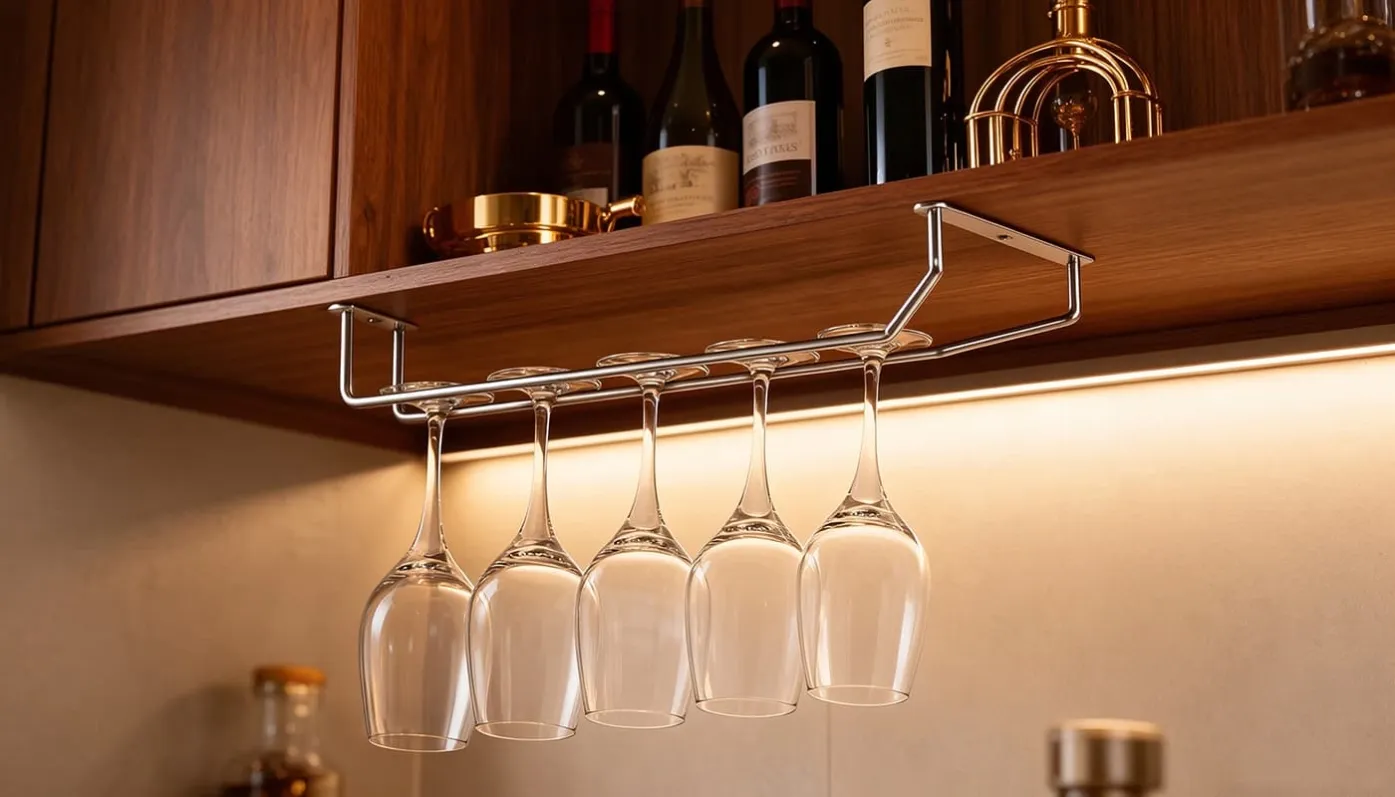
Retail buyers increasingly think in families, not SKUs. A single basic rack platform can support optional modules — a cutting board holder, a wine glass rack, a cup rack, an extra utensil caddy — which lets a brand:
- test a market with the basic configuration first,
- add accessory SKUs once demand is proven,
- and give repeat customers a reason to trade up.
Our own line follows this logic: the A2110 platform offers a basic version, a cutting-board-rack version (A2110-L) and a wine-glass-rack version (A2110-L2); the A201128 series offers basic, "C" and wine-glass-rack configurations at different price points. This structure is also ideal for private-label programs, where packaging can be shared across the family.
5. Color and finish as shelf differentiation
Finally, matte black remains the workhorse finish of the category, but the demand for color is real — especially in housewares retail and e-commerce where a pale pink or sage-green dish rack (see our A2406-2 or A01S-5 PVC dip-coated series) can double click-through rates in search results. Custom colors are now a standard part of our OEM support, alongside custom handle colors, logo application and retail packaging.
Building the range without over-ordering
The practical question for most buyers is not what to stock but how much to commit to each SKU. This is where low MOQs with mixed-item containers matter: launching one entry wire rack, one two-tier expandable, one sink caddy and one anti-fingerprint stainless flagship in a single mixed container lets you test a complete trend-aligned range — instead of betting a full container on a single SKU.
If you are planning a 2027 organization assortment, send us the item numbers you want to evaluate. We will confirm material, finish, MOQ and carton quantities, quote FOB / EXW / DDP, and arrange samples for testing.
Contact: info@lkhousehold.com · WhatsApp +86 185 7586 4047 · www.lkhousehold.com